


Square Mile Of Murder - Horrific Glasgow Murders
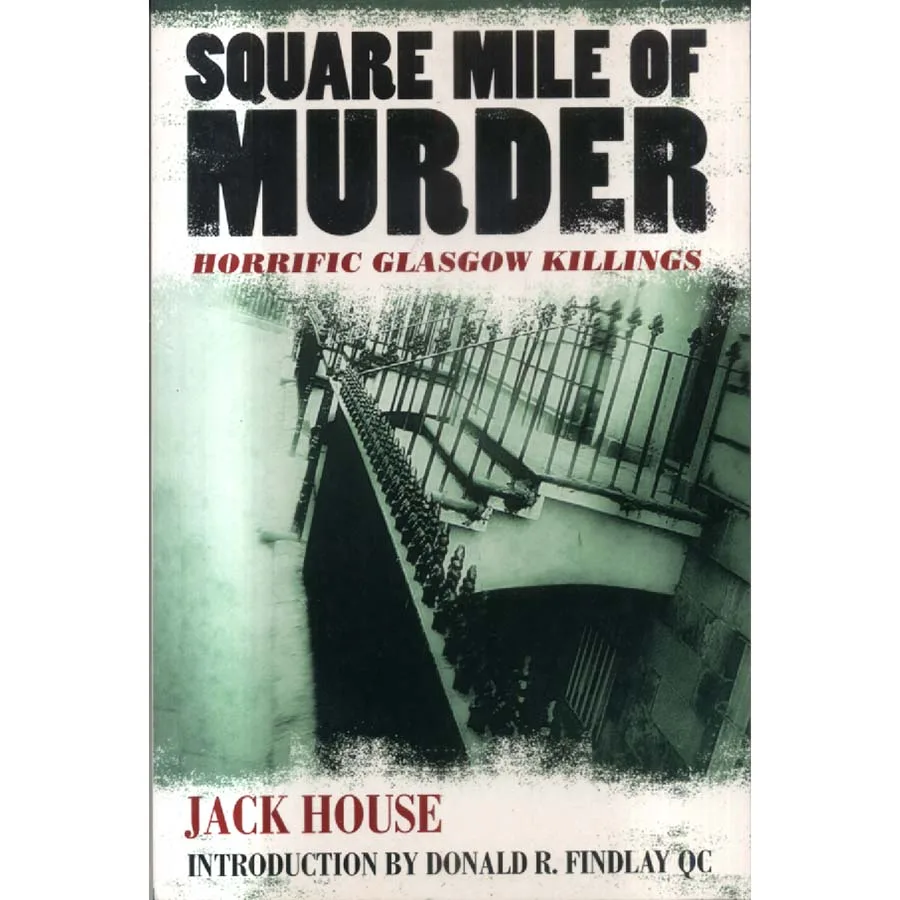
Publisher: Black and White Publishing
Format: Paperback
ISBN: 9781902927411
Square Mile of Murder: Horrific Glasgow Murders (2002) – Jack House
Black & White Publishing | ISBN: 9781902927411
Condition: Good | Sold by Crappy Old Books
Glasgow. A magnificent city of imposing Victorian architecture, industrial achievement, formidable humour and a population renowned for its ability to deliver an insult with such extraordinary wit that the recipient may find themselves laughing before realising they’ve been thoroughly demolished. But beneath the city’s proud history of shipbuilding, commerce and cultural accomplishment lies another, rather less reassuring tradition: murder.
And Glasgow, it must be said, has produced some particularly memorable examples.
Welcome to Square Mile of Murder: Horrific Glasgow Murders, Jack House’s chilling exploration of notorious killings and criminal investigations associated with Scotland’s great industrial city. Here, the familiar streets and respectable buildings of Glasgow become the backdrop to stories of violence, deception, suspicious deaths and the extraordinary things human beings are capable of doing to one another when ordinary disagreements become catastrophically unpleasant.
Jack House was one of Glasgow’s best-known journalists, broadcasters and local historians, a writer whose fascination with the city’s colourful past extended well beyond its celebrated buildings and distinguished citizens. He understood that urban history is not merely a procession of civic achievements, famous personalities and ceremonial occasions. Sometimes it involves a body, a suspiciously convenient explanation and a detective who refuses to believe that everything is quite as straightforward as it appears.
Among the city’s most infamous criminal cases is that of Dr Edward Pritchard, the nineteenth-century physician whose domestic arrangements included the deeply questionable practice of poisoning people close to him. His crimes brought scandal to Victorian Glasgow, demonstrating that professional respectability and a medical qualification were not necessarily reliable indicators of moral character.
Then there is Madeleine Smith, whose celebrated 1857 trial for the alleged poisoning of her lover became one of Scotland’s great courtroom sensations. Romantic correspondence, social expectations and an exceptionally inconvenient death combined to produce a legal drama whose outcome has fascinated generations of criminal historians.
Glasgow’s criminal past offers no shortage of such stories, where apparently ordinary households conceal extraordinary secrets and the polished exterior of respectable society proves a remarkably unreliable guide to what is happening behind closed doors.
House approaches this darker side of local history with a storyteller’s appreciation of character, atmosphere and the unsettling details that distinguish genuine criminal cases from the comfortable inventions of detective fiction.
There is something especially disturbing about historical murder investigations. Modern forensic science, DNA profiling and sophisticated surveillance were unavailable to nineteenth-century detectives, who frequently depended upon witness testimony, circumstantial evidence and the occasional fortunate discovery that somebody had purchased an unusually large quantity of poison.
The consequences could be dramatic, particularly when a person’s fate depended upon the persuasiveness of competing barristers and the conclusions of a jury.
This 2002 Black & White Publishing edition, offered in Good condition by Crappy Old Books, is an appealing acquisition for enthusiasts of Scottish true crime, Glasgow local history, Victorian criminal investigations and the occasionally alarming relationship between domestic respectability and murderous behaviour.
A fascinating journey into Glasgow’s darker history, where familiar streets conceal extraordinary stories and the past proves every bit as disturbing as the modern crime headlines.
Because while Glasgow has long been celebrated for its humour, hospitality and extraordinary civic character, some of its historical residents displayed rather less admirable talents.
And a useful reminder that when somebody describes a neighbourhood as being full of character, it might be sensible to inquire precisely what sort of characters they have in mind.
Particularly if one of them happens to be a doctor with an unusually enthusiastic interest in arsenic.
Keep browsing: See more Crime books Other books by Jack House
